





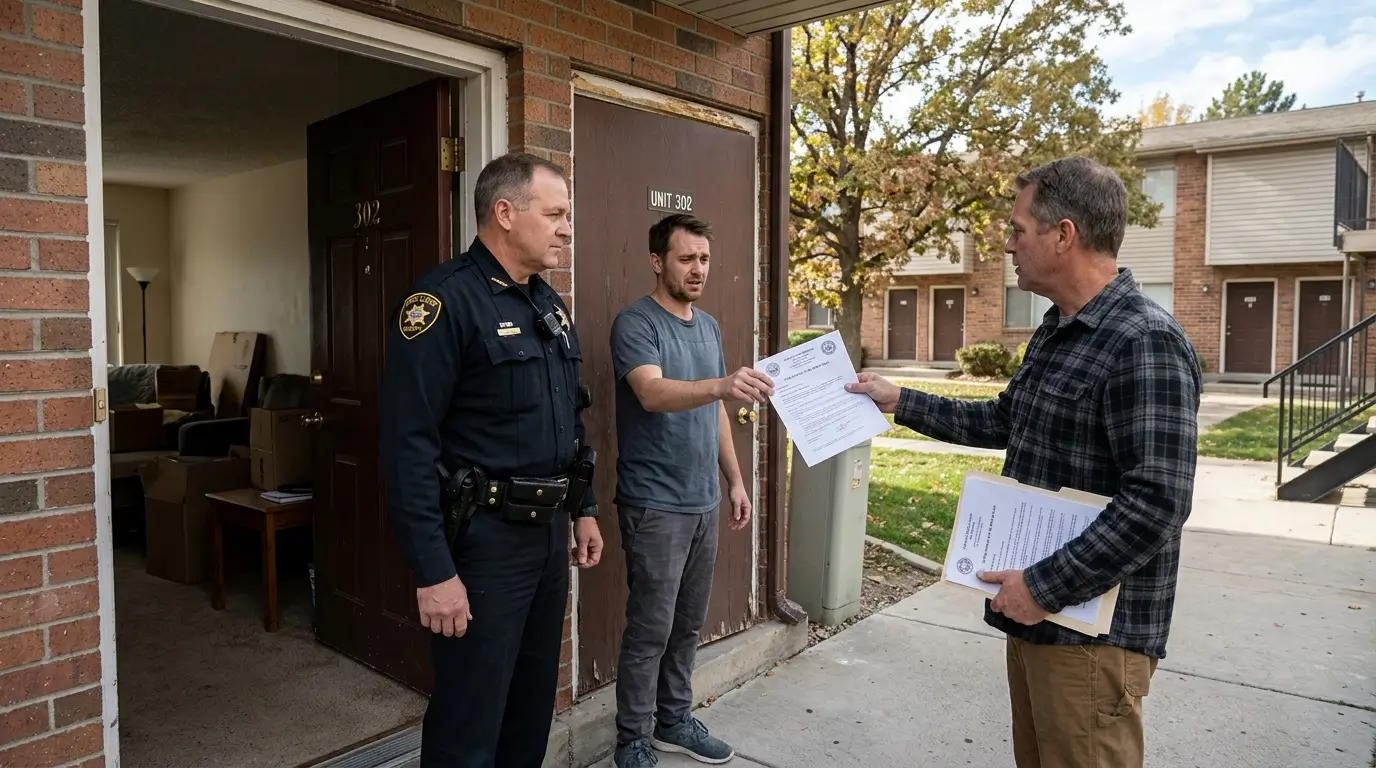
No owner buys a rental property hoping to evict someone. Still, if you own rentals in Salt Lake City long enough, you may eventually face a tenant who stops paying, causes serious damage, or refuses to leave. When that happens, knowing the Utah eviction process can be the difference between a case that wraps up in a few weeks and one that drags on because of a defective notice.
Utah's eviction procedure is one of the fastest in the country, but it's also unforgiving of mistakes. Below, we walk through the notices, the court timeline, and the errors we see most often from self-managing landlords along the Wasatch Front.
Key Takeaways
Utah evictions start with a written notice, and the type of notice depends on the reason for the eviction.
Nonpayment notices give tenants three business days to pay or move, while most other notices use calendar days.
Tenants usually have only three business days to file an answer after being served with a summons.
Only a court-issued order of restitution allows a landlord to remove a tenant. Self-help evictions create serious legal risk.
Most evictions that fall apart do so because of notice and paperwork errors, not because the landlord lacked a valid reason.
Step One: Serve the Correct Eviction Notice
Every Utah eviction starts with a notice. The notice requirements are found in Utah Code 78B-6-802, and choosing the wrong notice or counting days incorrectly is the most common reason cases get dismissed.
Three-Day Notice to Pay or Vacate
When a tenant falls behind on rent or other amounts due under the lease, the landlord can serve a written notice requiring the tenant to pay in full or move out. The tenant has three business days after service to comply. Business days exclude weekends and Utah legal holidays, and the day of service doesn't count. A notice served on a Thursday afternoon, for example, won't expire until the following Tuesday.
Three-Day Notice to Comply or Vacate
For lease violations that can be fixed, such as an unauthorized pet or a parking issue, the landlord can serve a notice requiring the tenant to correct the problem or leave. This notice gives the tenant three calendar days after service to comply.
Three-Day Notice to Quit
Certain serious violations don't come with a chance to fix the problem. Utah law allows a three calendar day notice to quit when a tenant:
Commits waste or significant damage, or sublets in violation of the lease
Runs an unlawful business on the property
Maintains a nuisance on or around the premises
Commits a criminal act on the property
Fifteen-Day Notice to Vacate
For month-to-month tenancies, a landlord who wants the tenant to leave without cause must serve notice at least 15 calendar days before the end of the rental period. The tenancy then ends at the close of that period. Fixed-term leases generally end on their expiration date without additional notice, although your lease may set its own renewal terms.
Step Two: File the Eviction Complaint
If the tenant doesn't pay, comply, or move by the deadline, the landlord can file a complaint for unlawful detainer in district court. The tenant must then be formally served with the summons and complaint.
According to the Utah Courts eviction summary, tenants generally have three business days after service to file an answer. If the tenant doesn't respond, the landlord can request a default judgment, which often resolves the case quickly.
Step Three: The Occupancy Hearing
If the tenant files an answer, either side can request an occupancy hearing, which usually happens within about 10 business days. Both parties exchange documents ahead of time, and the judge decides whether the landlord is entitled to possession of the property.
This is where preparation matters. Bring the lease, the notice, proof of service, a rent ledger, photos, and records of every communication. Judges see a lot of eviction cases, and an organized landlord with clean documentation is in a much stronger position.
Step Four: The Order of Restitution
If the judge rules for the landlord, the court issues an order of restitution. Once that order is served, the tenant typically has three days to move out. If the tenant still doesn't leave, a sheriff or constable can carry out the removal. The court may also award a money judgment for unpaid rent, damages, and other amounts owed under the lease.
The order of restitution is the only legal path to removing a tenant. Changing the locks, shutting off utilities, or putting a tenant's belongings on the curb without one can expose an owner to significant liability, even when the tenant hasn't paid in months.
Common Eviction Mistakes Utah Landlords Make
Most failed evictions don't fail because the landlord was wrong. They fail on technical errors. Here are the mistakes we see most often.
Counting Days Incorrectly
Mixing up business days and calendar days is the classic error. A nonpayment notice that gives three calendar days instead of three business days can be defective, and the landlord may have to start over.
Using the Wrong Notice
A tenant who hasn't paid rent and also has an unauthorized roommate may need more than one notice, or a carefully drafted combined notice. Using a pay or vacate notice for a nuisance problem, or the reverse, can sink the case.
Improper Service
Notices must be served in a way the law recognizes. Texting a photo of the notice or sliding it under the door without proper follow-through may not hold up in court. Document how, when, and by whom the notice was served.
Accepting Partial Payment
Taking partial rent after serving a notice can complicate or even waive the eviction, depending on the circumstances. Talk to an attorney before accepting money from a tenant once the process has started.
Letting Emotions Drive Decisions
Evictions are stressful, and frustrated owners sometimes make threats, show up unannounced, or communicate in ways that later look bad in court. Keep every interaction professional, written, and focused on the lease.
The Best Eviction Is the One You Avoid
At Maxfield, our primary directive is protecting our owners' investments, and the most effective way to do that is preventing evictions in the first place. Consistent tenant screening services, clear leases, and reliable rent collection practices have helped us maintain one of the lowest default rates of any property manager in the state.
When an eviction does become necessary, our trouble tenant and eviction services are built to move quickly and correctly, so owners can get their property back to rent-ready condition without the guesswork.
This article is for general information only and isn't legal advice. For a specific situation, consult a Utah attorney who handles landlord-tenant matters.
Frequently Asked Questions About Evictions in Utah
How long does an eviction take in Utah?
An uncontested nonpayment eviction can move from notice to order of restitution in a few weeks. Contested cases, service problems, and notice errors can extend that timeline.
Can a Utah landlord evict a tenant without going to court?
No. A landlord needs a court-issued order of restitution to remove a tenant. Lockouts, utility shutoffs, and removing a tenant's belongings without one can create serious liability.
Do weekends count in a Utah three-day eviction notice?
For nonpayment of rent, no. The notice runs three business days, which excludes weekends and state holidays. Most other three-day notices use calendar days.
Can a tenant stop an eviction by paying the rent?
Paying the full amount demanded within the three business day notice period cures the default. After the deadline passes, the landlord generally isn't required to accept payment.
Protecting Your Rental When a Tenancy Goes Wrong
The Utah eviction process is fast and clearly defined, but it rewards landlords who follow every step exactly. Serve the right notice, count days carefully, document everything, and never take matters into your own hands.
Owners who would rather not navigate evictions alone have options. Our Investor Club plan covers up to the first $1,000 of any eviction, and Full Service clients can add the same protection for a small monthly fee. Compare our property management pricing plans to find the level of protection that fits your portfolio.